
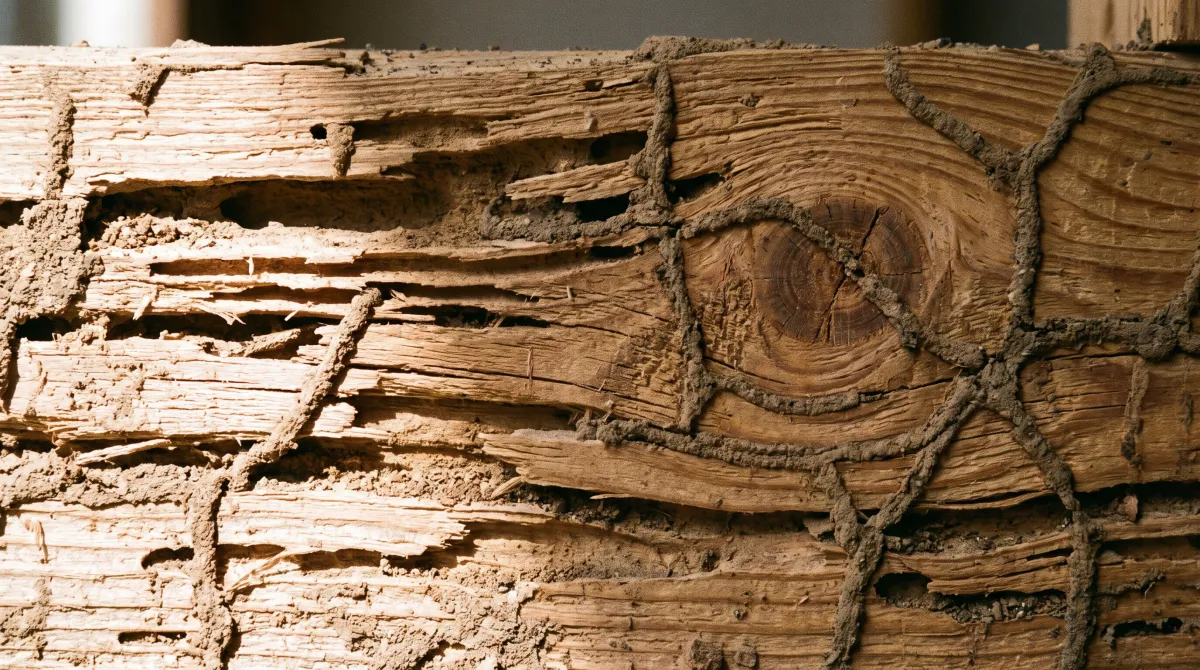
A termite swarm near your home tells you termites are flying in the area. It does not tell you they are in your house.
Here is why. Victoria's Department of Health says termites are not strong fliers and usually travel only up to 1 km. The Australian Museum says the most destructive species attacks wooden structures within about 50 m of its nest.
Our arithmetic: 1 km is 1,000 m, and 1,000 divided by 50 is 20. So the winged termite on your back step may have come from a nest up to about 20 times further away than that species' attack reach. That is our estimate, worked from two separate sources, and neither states it.
What the swarm can't tell you is where the nest is. A timber pest inspection is how you find out.
Does a termite swarm mean your house has termites?
Not on its own. A swarm means a colony somewhere within flying distance has sent out its reproductives. That colony could be under your house, in a neighbour's stump or in bushland down the road.
It also may not be a pest at all. Only a few of Australia's 258 described termite species damage wood. The Australian Museum notes that nests near bushland may not contain pest species, and that identification is specialised and should come before any treatment.
The species to worry about is serious, though. Coptotermes acinaciformis is the most destructive overall, and it nests in stumps, living trees, spaces under buildings and even walls.
So a swarm is a signal. Whether termites are working in your timber is a question for an inspection, and even an inspection is a check of the house at one point in time.
Why do termites swarm in spring and autumn?
A swarm is how new colonies start. Winged reproductives leave the nest on a colonising flight in warm, humid weather, usually in spring and autumn. The CSIRO puts it more precisely: reproductives usually fly "on warm humid nights".
The weather has to be right. Victoria's Department of Health says swarms leave in high humidity, still air and sometimes low light. That means a muggy, windless spring evening around the porch light.
Distance depends on the wind. They are weak fliers and usually cover up to 1 km, but a breeze can carry them further.
After landing, the pair shed their wings. Those dropped wings are often the first thing a homeowner notices.
Flying ants or termites?
| Feature | Winged termite | Flying ant |
|---|---|---|
| 1 Waist | None: the body runs straight through | Pinched waist |
| 2 Antennae | Straight and bead-like | Elbowed |
| 3 Abdomen end | Blunt | Pointed |
| 4 Wings | Fore and hind wings equal in size | Unequal and strongly veined |
"White ants" are not ants: termites belong to a different insect order, Isoptera, from true ants, Hymenoptera, according to the Australian Museum.
That difference shows on the body. The museum's guide to the differences between ants and termites gives four checks that tell them apart:
- Waist. A termite has none, so its body runs straight through. An ant has a pinched waist.
- Antennae. A termite's are straight and bead-like. An ant's are elbowed.
- Abdomen end. Blunt on a termite, pointed on an ant.
- Wings. A termite's fore and hind wings are equal in size. An ant's are unequal and strongly veined.
If what you're looking at has a pinched waist and bent antennae, it is probably a flying ant. If it is straight-bodied with matching wings, take it seriously.
What should you do with shed wings or a few insects?
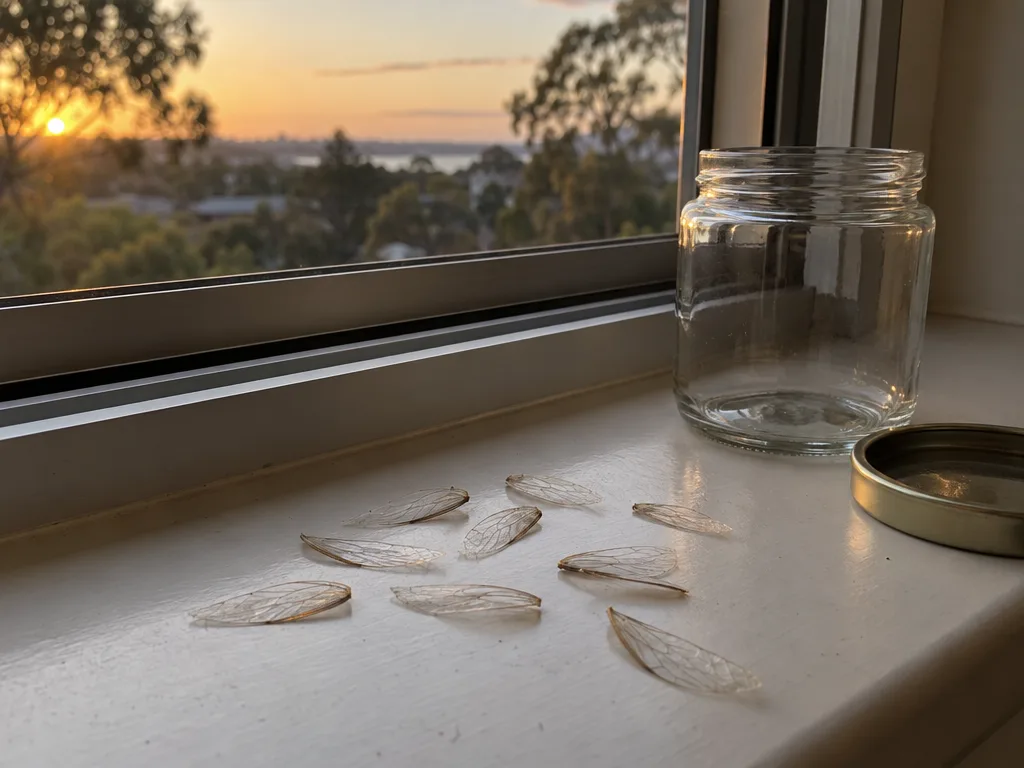
Victoria's Department of Health says shed wings are "a good indication of termite presence". That is presence in the area, and it is worth acting on.
Our general advice is to keep a sample rather than spray it. Identification is specialised, and an inspector can only identify what is left to look at.
- Sweep wings or insects into a clean jar or zip-lock bag and seal it.
- Write down the date, the time and exactly where you found them: window sill, garage door, porch light.
- Photograph them where they lay before you move them.
- Look nearby for the signs an insurer's guide lists: mud tubes, hollow-sounding wood and bubbling paint. Don't break into anything you find.
- Arrange a timber pest inspection.
Where do termites find water around a house?
- 1A roof leak (Australian Museum)
- 2A gutter and downpipe dumping water against the footing (insurer's guide)
- 3A leaking pipe under the kitchen sink (Australian Museum; Vic Health)
- 4A damp, poorly ventilated subfloor (Vic Health)
- 5Pot plants standing on pavers against the wall (Australian Museum)
- 6Garden soil heaped against timber (Vic Health)
- 7Firewood stored on the ground against the building (Vic Health)
Water is the part of this you control. Subterranean termites gain most of their water from soil, and the Australian Museum says they "can only become pests in buildings where a constant water source is available". It names indoor plants on pavers and leaking pipes or roofs as major causes.
Victoria's Department of Health lists soil, leaking plumbing and decaying timber as moisture sources for nests. Its advice for reducing risk is practical:
- keep soil off susceptible timber
- keep subfloors ventilated and dry
- don't store wood on the ground against the building
An insurer's guide adds two more: fix leaks, and divert gutter and downpipe water away from the house.
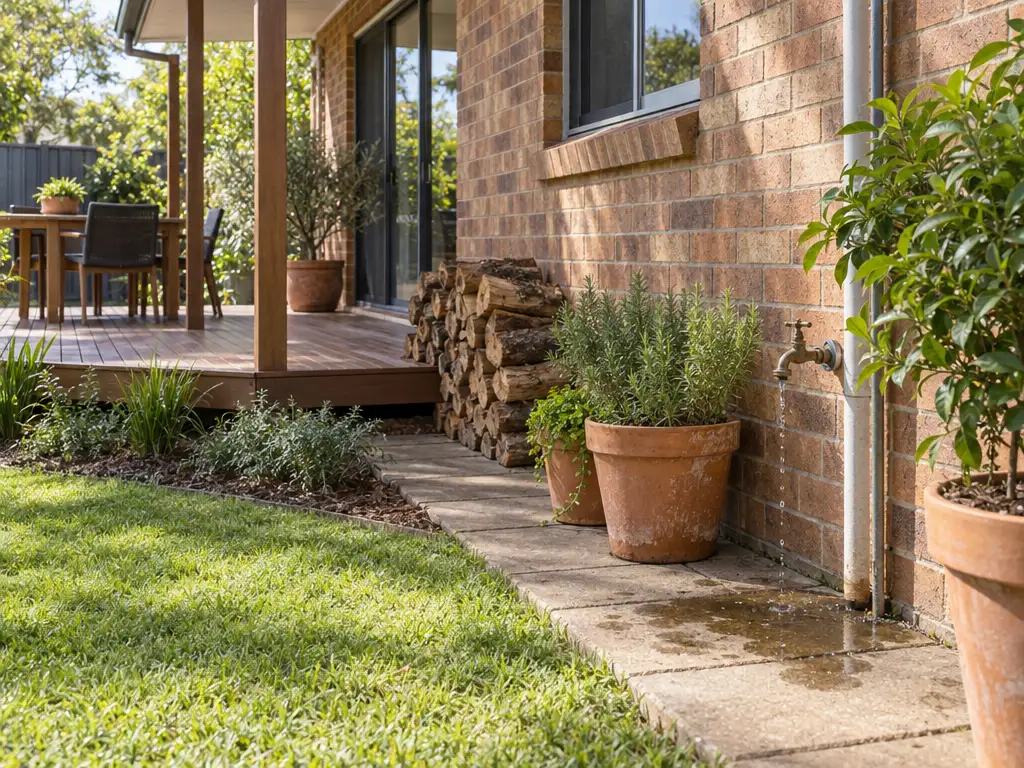
On a typical Western Sydney block, walk the outside of the house looking for:
- a dripping garden tap
- a downpipe that empties against the slab or footing
- pot plants on pavers hard against the wall
- garden beds or mulch built up against timber posts or cladding
- firewood stacked against the house
Then open the cupboard under the kitchen sink, and check the bathroom for any slow leak.
One caution: drying the place out lowers the risk without removing it. The museum notes that termites in dry wood have weaker water needs and may attack wood that is not especially damp.
Buying a home during flight season: what should you check?
| What the source says | What it means for a buyer |
|---|---|
| The builder installing new work is responsible for a termite risk management system (NSW Government) | For a newer home, ask for the inspection report to cover the termite management system the property has |
| Some contracts may try to shift that liability to the owner (NSW Government) | Read the contract |
| Control combines annual inspections in termite-prone areas, resistant or treated timbers and soil barriers (Australian Museum) | No single item on that list does the job alone |
| Most insurers do not cover termite damage, because it is preventable (insurer's guide) | If you buy a house with termite damage, the damage would be yours to fix |
| Commission a pest inspection before you buy (insurer's guide) | A pre-purchase timber pest inspection checks what can be seen and accessed on the day: a snapshot, not a guarantee |
If you are buying, the stakes are higher, because the damage would be yours to fix. Home insurance does not usually cover termite damage: an insurer's guide, Floods, bushfires and termites: what does home insurance cover?, says most insurers exclude it because it is preventable. The same guide advises commissioning a pest inspection before you buy.
A pre-purchase timber pest inspection is a check by a qualified inspector of what can be seen and accessed on the day. It is a snapshot, not a guarantee. Ask for the report to cover any termite management system the property has.
For newer homes, the NSW Government says the builder installing new work is responsible for a termite risk management system. It also says "An effective TRM system, combined with regular inspections, can significantly reduce the risk of termite damage". It warns that some contracts may try to shift that liability to the owner, so read the contract.
The Australian Museum describes control as a combination of annual building inspections in termite-prone areas, resistant or treated timbers, and soil barriers. No single item on that list does the job alone.
This is the same lesson our guide to strata handover paperwork drew: a document about a building is not an inspection of it. For how the different checks fit together, see Your Ultimate Guide to Property Inspections in Blacktown.
Termite flight season in numbers
Spring and autumn
Flight season: usually spring and autumn, in warm humid weather (Australian Museum)
1 km
Termites usually fly up to 1 km (Vic Health)
50 m
Coptotermes reach from nest: within about 50 m (Australian Museum)
258
Termite species in Australia: 258 described, only a few damage wood (Australian Museum)
Four figures sum up the season:
- Flights usually happen in spring and autumn, in warm, humid weather.
- Termites usually fly up to 1 km.
- The most destructive species attacks timber within about 50 m of its nest.
- Only a few of Australia's 258 described species damage wood.
Together they explain why a swarm is a question rather than an answer.
Seen a swarm or shed wings? Here's the next step
Keep the sample, note where and when you found it, and get the house looked at by a qualified timber pest inspector.
If you're buying in Blacktown or Western Sydney, Blacktown Building Inspections does pre-purchase building and pest inspections. Use our enquiry form. Tell us the property's suburb and anything you've seen, such as wings on a sill or a swarm at the porch light, and we'll take it from there.
Sources
- https://australian.museum/learn/animals/insects/termites/
- https://australian.museum/learn/animals/insects/termites-as-pests/
- https://australian.museum/learn/animals/insects/what-are-the-differences-between-ants-and-termites/
- https://www.ento.csiro.au/education/insects/isoptera.html
- https://www.health.vic.gov.au/environmental-health/pest-control-termites
- https://www.nsw.gov.au/housing-and-construction/building-or-renovating-a-home/after/safety-and-standards
- https://www.anz.com.au/personal/insurance/guides-to-insurance/floods-bushfires-and-termites-what-does-home-insurance-cover/